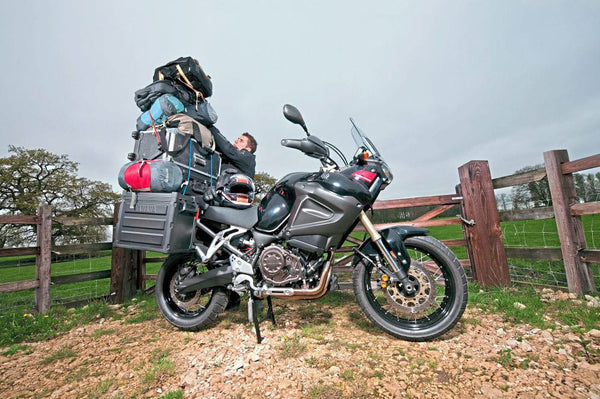
How Much Can You Carry on a Motorcycle? Weight Limits and Packing
Your motorcycle weight limit is set by the manufacturer, and you will find it in your owner's manual as the maximum load, load capacity or payload. That number covers everything on the bike except the bike itself: you, a passenger, your gear, your luggage and any accessories you have added, so the luggage allowance is whatever is left after the people.
There is no single motorcycle weight limit that applies to every bike, and a number from a forum or a different model is not a safe stand-in. Read the figure for your own bike, then use the steps below to work out what you can pack and how to pack it so the bike still handles and stops the way it should.
Where to find your motorcycle's weight limit
Start with the owner's manual. Most manufacturers list a maximum load (sometimes called maximum payload or load capacity) in the specifications or the loading section. Some also give a gross vehicle weight rating (GVWR), which is the bike plus everything on it. If the manual gives only the GVWR, subtract the bike's curb weight (fuelled and ready to ride, as listed in the same manual) to get the load you can add.
Many bikes also show the GVWR on the compliance label with the vehicle identification number (VIN), usually on the steering head or the frame, and some have a loading or tire label under the seat. If two sources ever seem to disagree, go with the lower number and ask your dealer. Two more limits sit inside the big one:
- Your tires. Every tire has a maximum load printed on the sidewall. Run the pressures your manual gives for a loaded bike or for riding two-up.
- Racks and top cases. A luggage rack or top case usually has its own, much smaller limit, often stamped on the rack or listed in its instructions. Respect it even when the bike's overall load is fine.
What counts against the load limit
Riders often forget that the load limit is not a luggage allowance. Everything below comes out of the same number.
| Item | Counts toward the limit? | How to get the weight |
|---|---|---|
| Rider, in full gear | Yes | Step on a scale wearing your jacket, pants, boots and helmet |
| Passenger, in full gear | Yes | Same as the rider |
| Saddlebags, tail bag, tank bag | Yes, packed | Weigh each bag full, before it goes on the bike |
| Accessories added after purchase | Yes | Racks, top case, crash bars, a bigger windshield: check their spec sheets |
| Camping gear strapped on top | Yes | Weigh it rolled up, with the straps |
| Fuel | Usually already in the curb weight | Check how your manual defines curb weight |
A quick way to work out your luggage allowance
Here is the arithmetic with round, made-up numbers (not any real bike). Say the manual lists a maximum load of 180 kg. You weigh 95 kg in your gear, your passenger weighs 70 kg in theirs, and you added a rack and crash bars that weigh 8 kg together. That leaves 180 minus 95, minus 70, minus 8: 7 kg for everything in your bags. Ride solo on the same bike and the allowance for luggage is 77 kg.
Do the same sum with your own numbers before a trip. It is the quickest way to see why riding two-up with full luggage is where most bikes run out of capacity first.
Going over the limit puts extra strain on the suspension and brakes and extra wear on the tires, and the bike will not steer or stop the way it was designed to.

How to pack a motorcycle so it still handles well
Staying under the limit is the first half. Where the weight sits matters just as much for how the bike steers, brakes and leans.
- Heavy and low. Put the heaviest items (tools, water, cooking gear) in the bottom of the saddlebags, close to the bike's centre. Weight up high and far back makes the front feel light.
- Balance left and right. Pack the two saddlebags to about the same weight. An uneven pair pulls the bike to one side in corners.
- Light on top and behind. A tail bag or a roll on the seat suits bulky, light things: sleeping bag, clothes, rain gear.
- Keep the tank bag light. Phone, wallet, snacks and maps. It should never touch the handlebars at full lock or block your view of the gauges.
- Clear of heat and wheels. Check that no bag or strap can touch the exhaust or the rear tire, empty and full.
- Adjust the bike. Set tire pressures and rear preload for the load, as your manual describes.
- Ride it loaded before the trip. A loaded bike takes longer to stop and feels slower to turn. Ten minutes in an empty parking lot shows you how it behaves before the highway does.

For a side by side look at what each type of bag is best for, read our guide to tail bags, tank bags and saddlebags.
Choosing luggage that keeps the weight where it belongs
Our soft motorcycle luggage is sized by volume in litres, not rated for weight, so the limit that matters is still your bike's. What a good bag does is hold the load low and steady and keep it off hot parts. All of these are in our motorcycle luggage collection.

Saddlebags: the place for the heavy items
- Voyager Motorcycle Saddlebags: the compact pair, 25 litres for both bags unexpanded and 44 litres expanded. Stiffeners keep their shape, the base is heat-resistant, and an anchor-knot system lets you take them on and off quickly, with a yoke that runs under the seat.
- Tourister Motorcycle Saddlebags: 38 litres minimum, expanding to 60. Top-loading main compartments with rigid inserts, a heat-resistant base, D-rings for extra cargo, and a quick-release mount with an under-seat centre strap.
- UltraMax Motorcycle Saddlebags: the longest of the three at 20 inches, up to 60 litres. Heat-resistant base, rigid inserts, under-seat centre strap, and a mesh bottle holder on the right bag for a passenger.
- Studded Throw-Over Cruiser Saddlebags: 47 litres in waterproof vegan leather for cruisers and touring bikes. Throw them over the passenger seat or mount the yoke under the seat. The product page gives two checks before you buy: measure horizontally from the edge of the rear turn signal to where the passenger's knees sit on the seat (at least 18.25 inches, 47 cm), and vertically from the exhaust pipe to the top of the rear fender (at least 13.5 inches, 34 cm).
The Voyager, Tourister and UltraMax each come with a rain cover per bag. The Tourister and UltraMax pages say why: the fabric is waterproof, but water can seep through the zippers in a heavy downpour.
In our reviews, owners run the Voyager on a Ninja 650 and the Tourister on an SV650 and a V-Strom.
Tail bags: bulky and light
- Navigator Motorcycle Tail Bag: 52 litres for bikes with a tail section 10.2 inches wide or less, with anti-slip cam buckles, hook-and-loop straps around the seat, and ten D-rings on top for a sleeping bag or roll bag.
- Urban Survivor Convertible Motorcycle Bag: 17 to 31 litres, works as a tank bag, a tail bag or a backpack.
Keeping straps off the exhaust
Our Luggage Assist Anchor Clips add attachment points, most often at the licence plate, so straps stay away from a hot exhaust where they could melt and let a bag drop. They fit surfaces under 11 mm thick with a 6 to 12 mm hole.
Riding two-up with luggage
Two-up touring is where the load limit bites. Weigh both riders in gear, subtract accessories, and only then plan the bags. Pack the passenger's things in the saddlebags rather than a backpack, and keep the tail bag light so it does not push against them. Make sure the bags sit clear of the passenger's feet and pegs. If the passenger wants something to hold on to, our Passenger Grab Handles are a grip belt worn by the rider with handles for the pillion.
- Voyager Motorcycle SaddlebagsCompact pair, 25 to 44 litres
- Tourister Motorcycle Saddlebags38 litres, expanding to 60
- UltraMax Motorcycle SaddlebagsLongest of the three, up to 60 litres
- Studded Throw-Over Cruiser Saddlebags47 litres for cruisers and touring bikes
- Navigator Motorcycle Tail Bag52 litres for bulky, light gear
- Luggage Assist Anchor ClipsKeep straps away from a hot exhaust
Questions riders ask us
Can I ride with a passenger with saddlebags on?
It depends on your bike. The Tourister and UltraMax mount with an under-seat centre strap and the Voyager with a yoke under the rear seat, and the UltraMax even has a bottle holder for the passenger. Before you ride two-up, check on your own bike that the passenger has room for their legs, that their feet reach the pegs without hitting the bags, that the bags sit clear of the rear wheel and the exhaust, and that the two of you plus the bags stay under the load limit.
Which saddlebags suit a smaller bike?
Compare lengths first. The Voyager is our shortest saddlebag at 14 inches and expands from 25 to 44 litres for the pair, the Tourister is 17 inches and the UltraMax 20 inches. Whichever you pick, hold the bag against your bike and check passenger room, the pegs, and clearance to the rear wheel and exhaust before you install it.
Do I need bag supports or brackets?
Not always, but they help. Several owners added saddlebag supports so the bags could not rub on the rear tire or swing toward the exhaust, especially when packed full and expanded. If a full bag moves toward the wheel when you push on it, add supports.
Will the bags sit too close to my exhaust?
Our saddlebags have heat-resistant bases, but clearance still depends on your bike. Check it with the bags full, keep straps off the pipes, and use anchor clips or supports where the gap is small.
How tight should the straps be?
Snug enough that a loaded bag does not shift when you push it by hand, and check again after the first few kilometres. Expanded bags need the straps rechecked more often, because the load can settle.
Tell us what you ride and what gear you already have, through the chat on any page or at (647) 400-3081, and we will help you pick the right fit.
Shop all GEARS gear